

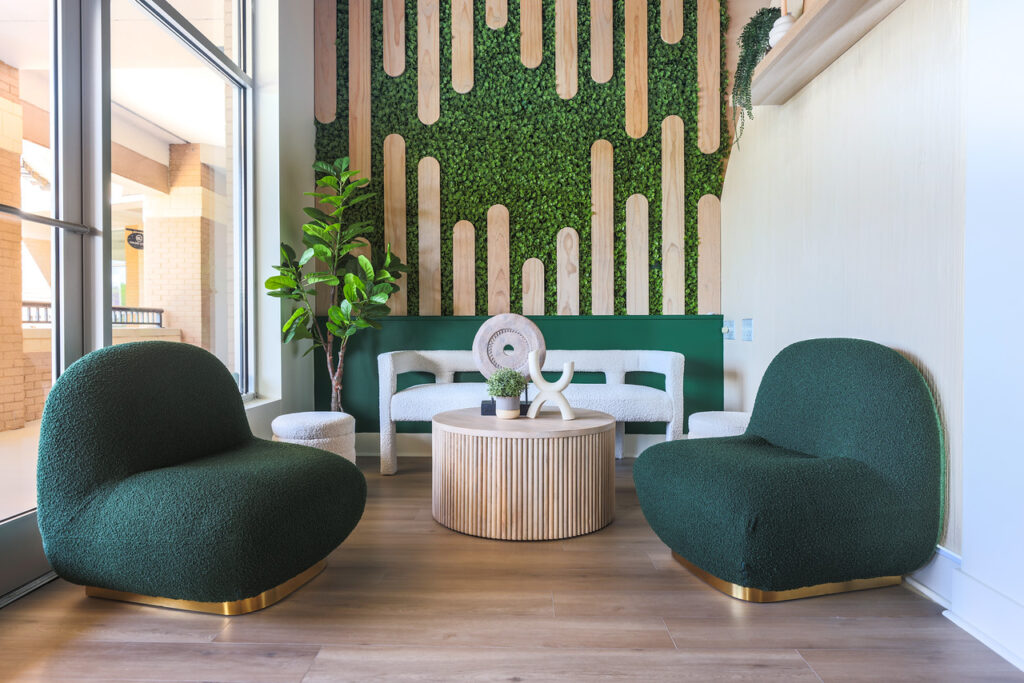
There are six trends that are defining commercial furniture trends in 2026 and beyond. And they’re showing up in nearly every project brief we see this year.
At TNT Commercial, we source and specify furniture for offices across Charlotte and the Southeast every day, which puts us in a good spot to tell you what’s happening versus what’s just talk.
Office furniture trends 2026 are being shaped by some distinctive pressures: noisy open floor plans, uncertain headcount and employers competing to get people back into the building. This article walks through the six trends worth budgeting for, what each one looks like in practice and what we’re hearing directly from clients.
Here’s a summary table on workplace design trends 2026 we are exploring further:
| # | Trend | What it looks like | Where it matters most |
|---|---|---|---|
| 1 | Acoustic-First Design | Pods, phone booths, panel-based privacy screens | Open-plan professional services & healthcare |
| 2 | Biophilic Design | Natural materials, organic forms, exterior sightlines | Reception, wellness-focused spaces |
| 3 | Flexibility & Modularity | Reconfigurable workstations, nesting tables, moveable partitions | Fast-growing companies, multi-tenant buildings |
| 4 | Sustainable & Certified Materials | GREENGUARD, BIFMA level, recycled content documentation | LEED projects, healthcare, ESG-driven clients |
| 5 | Hospitality-Inspired Spaces | Lounge seating, cafe-style zones, hotel-lobby reception | Reception, executive floors, employer-brand spaces |
| 6 | Height-Adjustable Everything | Sit-stand desks, adjustable conference & training tables | Every specification, now baseline expectation |
How We Identified These Trends
These six trends are drawn from two sources:
The first is direct experience. TNT Commercial specifies furniture for commercial spaces across Charlotte and the Southeast on a weekly basis.
When five different clients in six months ask for the same thing unprompted, like acoustic pods, adjustable conference tables, GREENGUARD documentation, that’s a stronger signal than any single trend report.
The second is published research on workplace design and well being. Studies on open-plan acoustics and concentration, the link between natural materials and stress reduction and the well being effects of movement and posture during the workday have been building for years.
Industry frameworks like BIFMA level and the WELL Building Standard also shape what gets specified, since they translate research findings into criteria that architects and procurement teams can actually apply.
We cross-check the two. A trend only makes this list if it shows up both in what clients are requesting and in the broader research and industry standards shaping commercial design. That’s also why this list stays at six. There are plenty of ideas that get pitched as the future of the office each year and most don’t hold up against both filters.
Trend 1: Acoustic-First Design – Pods, Phone Booths and Privacy Screens
Open-plan offices were built for collaboration. And they delivered it, along with a noise problem nobody quite planned for. That’s why acoustic office furniture started showing up as a line item from day one of a fit-out.
In practice, this shows up in three product categories:
- Freestanding pods give people a fully enclosed space for calls or focused work without booking a conference room.
- Phone booths do the same job at a smaller footprint, ideal for open floors with heavy call volume.
- Panel-based privacy screens offer a lighter option, enough sound dampening and visual separation to cut down on distraction without walling off the whole floor.
In the Charlotte area, we’re seeing the strongest demand for acoustic office solutions from professional services firms and healthcare tenants, both of which deal with sensitive conversations and can’t afford a floor plan that broadcasts everything. It’s become one of the first questions we ask when a client sends over a new project brief.
Trend 2: Biophilic Design – Materials, Plants and Organic Shapes
Biophilic design used to be something you’d see in a boutique hotel lobby or entertainment venues. Now it’s a standard part of commercial interior design trends and you can see it in corporate offices, healthcare waiting rooms, dining spaces and everything in between.
In a commercial furniture specification, biophilic office design means paying attention to material selection. Client opt for natural stone, visible wood grain, textured fabrics – alongside furniture with softer, organic forms rather than sharp corporate angles. It also means thinking about sightlines to the exterior wherever the floor plan allows it.
The reasoning behind it isn’t just aesthetic. Research linking natural materials and greenery to lower stress and better focus is well established at this point and we’re seeing clients reference those studies directly in their design briefs.
On our end, we work closely with suppliers who carry natural-finish and texture-forward options, so this is something we can build into a spec from the earliest conversations rather than retrofitting later.
We saw this play out directly when we worked with NOBU Beautique Hair & Spa in Ballantyne. As a European-style salon and spa, the space needed to feel calming the moment a client walked in, so we leaned on natural textures and softer, organic furniture forms throughout the treatment and styling areas, rather than the harder-edged fixtures typical of a standard salon buildout. It’s a good example of biophilic choices doing real work in a space where client comfort is the whole point.
On our end, we work closely with suppliers who carry natural-finish and texture-forward options, so this is something we can build into a spec from the earliest conversations rather than retrofitting later.

Trend 3: Flexibility and Modularity
Occupancy patterns still haven’t settled down. Hybrid schedules, fluctuating headcount, teams that grow faster than a lease term – all of it means clients are considering buying commercial furniture that can move with them.
Modular office furniture covers a specific set of solutions:
- Reconfigurable workstation systems that can be rearranged as team sizes shift.
- Resting tables that adapt a room from training session to all-hands meeting.
- Stackable seating for spaces that need to flex fast.
- Movable partitions that redraw a floor plan without construction.
There’s a procurement trade-off worth naming honestly. Modular systems generally cost more per unit upfront than fixed furniture. But over a five-to-seven-year cycle, the reduced need for full replacement tends to even that out, sometimes more than even out, depending on how much the space changes.
We see this trend most clearly with fast-growing companies who don’t know what their headcount looks like in eighteen months, coworking-adjacent offices and multi-tenant commercial buildings where the next tenant’s needs are anyone’s guess.
Ready to Move From Template to Real Numbers?
Share your project scope and we’ll put together a detailed FF&E proposal itemized by category, with lead times and installation included.
Trend 4: Sustainable and Certified Materials
Sustainability in commercial furniture has become a requirement, especially for LEED-certified projects, healthcare environments, corporate clients working under formal ESG commitments. If your project falls into any of those categories, certification is part of the spec.
There are three certifications that are important in commercial procurement right now:
- GREENGUARD certified furniture addresses indoor air quality, verifying low chemical emissions. These are critical for healthcare settings and any LEED points tied to interior air quality.
- BIFMA level certification looks at sustainability more holistically, covering the full lifecycle of a product.
- Recycled content declarations give project teams the material transparency that’s increasingly required in procurement documentation.
These certifications need to be requested at the specification stage. Ask suppliers directly which products carry which certifications and get documentation in writing before you finalize a spec.
On our side, a meaningful share of our supplier relationships already cover GREENGUARD and BIFMA-certified lines, which means we can usually match a certification requirement without limiting the design options available.
In this article, we talk more about healthcare furniture requirements, covering what are non-negotiable rules to follow when furnishing healthcare facilities.
Trend 5: Hospitality-Inspired Office Spaces
The line between office furniture and hospitality furniture is getting harder to find.
Employers that are trying to get people back into the office are specifying lounge-quality seating, cafe-style collaboration areas and reception spaces that feel closer to a boutique hotel lobby than a traditional front desk.
With that being said, hospitality office design in a commercial context doesn’t mean residential softness. Your workplace shouldn’t be designed to feel like home.
It’s about the quality of material, the level of comfort and the visual impression that a well-designed hotel lobby or restaurant creates the moment someone walks in. That standard is now showing up in commercial specs.
This applies most to reception areas, informal collaboration zones, all-hands and town-hall spaces and executive floors. Basically, the parts of an office that shape a visitor’s or employee’s first impression, or that need to work harder to make in-person time feel worth it.
The procurement reality is that hospitality-grade furniture costs more upfront than standard office seating. But clients are treating that as an investment with a longer perceived lifespan and a direct signal to employees and visitors about how the company sees itself.

Trend 6: Height-Adjustable Everything
Height adjustable desks have reached mainstream adoption and most commercial clients now request sit-stand as the default rather than an upgrade they have to ask for separately. The story in 2026 is where this principle is heading next.
The expansion is happening beyond the individual workstation. Height-adjustable conference tables are showing up in specs for teams that want a room to work for both seated meetings and standing check-ins. Standing collaboration surfaces are appearing in open work areas. Even training rooms are being specified with adjustable furniture, so the same space can support different formats without a redesign.
This shift changes how we think about a spec from the start. Instead of treating sit-stand as something to add to individual desks alone, we’re building the adjustability into shared and team spaces as a baseline expectation.
On lead times: adjustable furniture, particularly larger table formats, can run longer than fixed alternatives, so it’s worth factoring into a project timeline early rather than as a late addition to the order.
What This Means for Your Next Project
Most of the projects we work on don’t need every trend covered in this article, simply because all of them might not cater to your needs or fit your budget. Picking the right ones, however, is usually the harder part, especially once a few stakeholders each have a different opinion about what the office should feel like.
That’s the conversation we have with clients before anything gets ordered. We look at the floor plan, talk through what the space needs to do and get honest about where the budget should go first and where it can wait. Sometimes that means starting smaller than a client expected.
Sometimes it means one trend matters a lot more than the other five combined. Send us your floor plan or project brief and we’ll walk through it with you.
Specifying for a 2026 Project?
TNT Commercial sources and installs commercial furniture across all six of these categories. Tell us about your project and we’ll put together a specification.
Frequently Asked Questions
Is height-adjustable furniture now standard in commercial offices?
Yes. Sit-stand desks have moved from a premium ergonomic upgrade to a standard specification in most commercial fit-outs. In 2026, the trend has expanded beyond individual workstations to height-adjustable conference and training tables. Check out our ergonomic office furniture guide for more insights.
What does biophilic design mean for a commercial furniture specification?
In a commercial context, biophilic design means incorporating natural materials (wood grain, stone finishes, textured fabrics), organic furniture forms and where possible, views to the exterior. It is not limited to adding plants. The goal is reducing visual stress and supporting well being.
What certifications should I look for in sustainable commercial furniture?
The three most relevant certifications for commercial procurement in 2026 are GREENGUARD (indoor air quality, important for healthcare and LEED projects), BIFMA level (a holistic sustainability standard for commercial furniture) and recycled content declarations for projects requiring material transparency. Here’s more about Job Corps furniture requirements for workforce housing.

 info@tntcommercial.com