

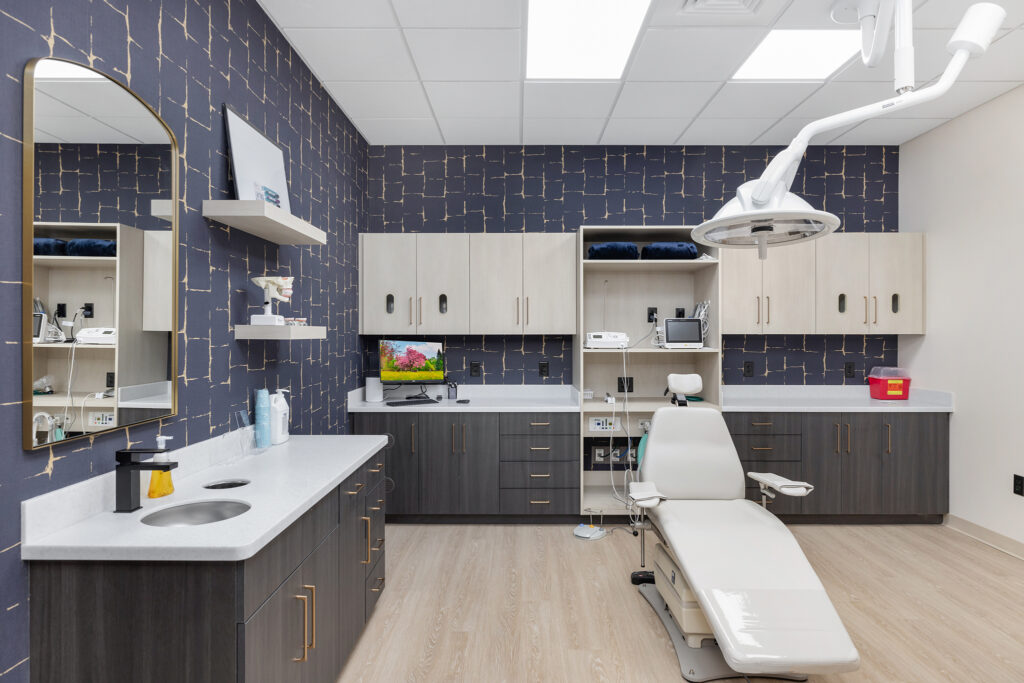
Healthcare furniture isn’t commercial furniture placed in a clinical setting. It has to meet a set of requirements that all apply at once: regulatory compliance, infection prevention, ergonomic access and the operational realities of a working clinical space.
In this space, a specification miss can become a compliance issue or a patient safety issue.
I put this guide together to walk through healthcare furniture requirements by certification, by room type and by the mistakes I see most often as we provide our end-to-end furniture procurement services at TNT Commercial.
If you already have the basics of healthcare compliance down, feel free to skip to the tables below.
Why Healthcare Furniture Is Different
Three things make healthcare furniture specification its own discipline rather than a variation on office furniture.
The first is cleanability under real conditions.
A lot of antimicrobial fabric looks great at first sight and passes its lab tests just fine. Then it goes into an actual exam room, gets wiped down with bleach-based disinfectant every day and within six months it’s breaking down. The spec sheet promised one thing. The daily reality of a cleaning crew doing their job promised something else entirely. And over time, that daily reality is what actually shapes how the furniture holds up.
The second is documentation.
ADA and BIFMA compliance are non-negotiable when it comes to healthcare furniture. And if a facility is under Joint Commission review, you need the paperwork sitting in a file somewhere, not just a supplier telling you the chair passed testing at some point.
The third is that furniture has to work inside a clinical workflow that has nothing to do with how it looks.
IV pole clearance, transfer paths for patients who can’t walk unassisted, equipment storage that doesn’t eat into the square footage a nurse needs to move quickly. A chair can be attractive, durable and still wrong for the room if nobody checked it against how staff actually move through the space.
None of this means healthcare furniture has to look institutional. It means the sourcing conversation needs to go past Does this look nice and hold up into specifics most commercial furniture buyers never have to ask. That’s the gap our healthcare furniture services team spends most of its time closing.
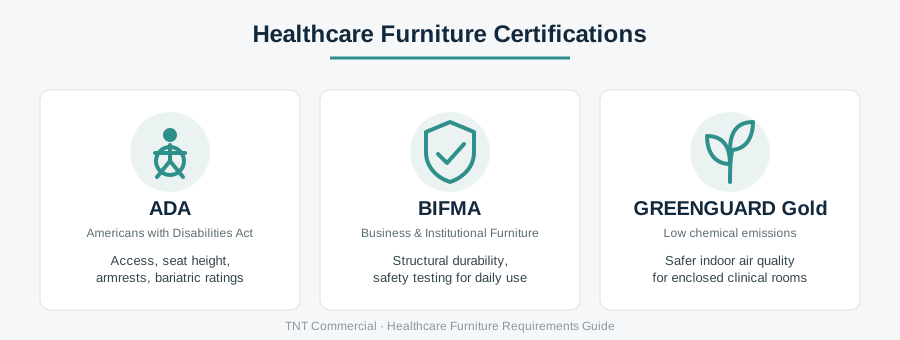
Key Certifications: ADA, BIFMA, GREENGUARD, Infection Control
Before you order a single piece of furniture, it helps to know what these four certifications actually mean and where each one matters most.
| Certification | What it covers | What it requires in practice | Most critical for |
|---|---|---|---|
| ADA (Americans with Disabilities Act) | Physical access for patients with disabilities | Correct seat height, sturdy armrests for support, clear floor space around furniture, bariatric weight ratings where needed | Waiting rooms, reception/lobby |
| BIFMA | Structural safety and durability testing for commercial furniture | Furniture tested for weight limits, stability and wear under everyday use | All rooms, especially high-traffic areas like waiting rooms and nurse stations |
| GREENGUARD Gold | Low chemical (VOC) emissions and indoor air quality | Furniture tested and certified for minimal off-gassing | Patient rooms, treatment rooms, anywhere immunocompromised patients spend time |
| Infection control standards | Cleanability and infection prevention | Bleach-cleanable or antimicrobial upholstery, sealed and seamless surfaces with no crevices for bacteria to collect | Exam rooms, treatment rooms, procedure rooms |
A few notes worth flagging for facility managers building out a spec:
- GREENGUARD Gold is the stricter of the two GREENGUARD tiers and it’s the one to ask for in any space where patients with weakened immune systems will be present.
- BIFMA certification is often treated as a baseline in general commercial furniture. In healthcare, it’s a starting point, not a finish line, infection control and GREENGUARD requirements layer on top of it.
- Ask suppliers for certification documentation up front, not after the order is placed. If a supplier can’t produce it in writing, that’s worth pausing on before you commit budget.
A supplier who can walk you through all four of these without hesitation is one who understands healthcare procurement.
Material Requirements by Room Type
Every room in a healthcare facility asks something different of its furniture. Here’s what to specify by room:
| Room type | Recommended upholstery | Recommended surface material | Infection control requirement | Key notes |
|---|---|---|---|---|
| Waiting room | High-durability antimicrobial fabric or vinyl | Cleanable laminate or solid surface | Cleanable with standard hospital-grade disinfectants | Include bariatric-rated seating options |
| Patient/Exam room | Impervious or seamless upholstery | Non-porous, seamless surfaces | Bleach-cleanable, no fabric seams | Seams trap pathogens, avoid them wherever possible |
| Nurse station | Ergonomic seating rated for extended sitting | Height-adjustable work surfaces where feasible | Cleanable, minimal soft furnishings | Prioritize ergonomics, this is where injury risk builds over a shift |
| Reception/Lobby | Antimicrobial upholstery | ADA-compliant layout, contrast detailing | Standard disinfectant cleanability | Contrast detailing helps visually impaired patients navigate the space |
| Treatment/Procedure room | Fully impervious upholstery | Clinical-grade cleanable surfaces on all contact points | Highest tier, every surface documented as cleanable | Layout must account for IV pole and equipment clearance |
Common Mistakes in Healthcare Furniture Procurement
I’ve seen these mistakes enough times that I can usually spot them from a walkthrough alone.
- Specifying commercial-grade furniture without verifying clinical cleanability. “Commercial grade” and “clinically cleanable” are not the same thing. Some facilities buy furniture that was perfectly durable but couldn’t stand up to hospital-grade disinfectants. That can turn the furniture itself into an infection control liability.
- No bariatric provision in waiting rooms. Skipping it creates real ADA exposure and in practice it forces staff to improvise workarounds on the fly, which is a bad position to put your team in.
- Skipping GREENGUARD certification in enclosed clinical spaces. VOC off-gassing sounds like a minor issue until you remember who’s sitting in these rooms for extended periods. For immunocompromised patients, this is a genuine risk, not a technicality.
- Treating every room as the same specification environment. I mentioned this above, but it’s worth repeating as a mistake in its own right: it consistently leads to under-specced patient rooms and over-specified staff areas, which is the opposite of where the budget should go.
- Not requesting compliance documentation in writing before purchase. A verbal claim that something is BIFMA-rated or GREENGUARD certified isn’t verifiable and it won’t hold up if you’re ever audited. Get it in writing, every time.
- Choosing a supplier based on price alone, without verifying healthcare procurement experience. I understand the pressure to stay on budget. But a supplier who hasn’t worked in clinical environments before often doesn’t know what questions to ask and you end up paying for that gap later, usually during an inspection.
Need Help Specifying to Healthcare Standards?
TNT Commercial has experience across clinical, dental and specialty healthcare environments. We handle specification, compliance documentation, procurement and installation in-house.
TNT Project Example: Harmony Oral Surgery, Tega Cay SC
I’ll walk through this one because it captures most of what I’ve described above in a single project.
Harmony Oral Surgery came to us with roughly 4,058 square feet to fit out in Tega Cay, South Carolina. The project ran about 35 weeks and it needed to work as a real clinical environment from day one, not just look like one.
We started with site analysis and workflow mapping, because furniture decisions don’t mean much without understanding how staff and patients actually move through the space.
From there, our scope covered clinical interior layout, hygienic and cleanable material selection, custom cabinetry and storage built around medical equipment, lighting designed to reduce patient stress while still supporting clinical visibility and compliance consulting against healthcare standards throughout.
The waiting area is where the tension I mentioned earlier- durability versus comfort- actually played out. We specified antimicrobial upholstery that could stand up to daily cleaning, but we didn’t want the space to feel sterile or cold to a patient walking in before oral surgery. That balance took real back-and-forth with the client and I think it’s the right way to approach every waiting room, not just this one.
For the consultation, treatment and recovery areas, cleanability took priority, as it should in any treatment-adjacent space. We documented every material choice against the compliance standards it needed to meet, so the practice had that documentation on hand well before any inspection.
If you’re comparing healthcare furniture suppliers for a similar project, I’d encourage you to ask for examples like this one. Not just a materials list, but a walkthrough of how the specification decisions were made room by room. You can see the full Harmony Oral Surgery project here.

Healthcare Furniture Procurement Checklist
A quick reference to run through before finalizing any healthcare furniture order.
Certifications to verify
☐ ADA compliance confirmed for seat height, armrest support and clearance space.
☐ Bariatric weight ratings specified for waiting room and reception seating.
☐ BIFMA certification confirmed for structural durability.
☐ GREENGUARD Gold certification confirmed for any enclosed clinical space.
☐ Infection control rating confirmed (bleach-cleanable or antimicrobial upholstery).
☐ Seamless, impervious construction confirmed for exam and treatment room furniture.
Room-by-room requirements
☐ Waiting room: durable, antimicrobial upholstery with bariatric options included.
☐ Patient/exam room: fully impervious surfaces, no fabric seams.
☐ Nurse station: ergonomic seating rated for extended use, adjustable work surfaces.
☐ Reception/lobby: ADA-compliant layout, contrast detailing for visually impaired patients.
☐ Treatment/procedure room: clinical-grade cleanability, IV pole and equipment clearance accounted for in layout.
Documentation
☐ Compliance certifications requested and received in writing.
☐ Cleanability standards documented per room type.
☐ Material specifications kept on file for future audits or replacements.
Supplier vetting
☐ Supplier has verifiable healthcare procurement experience.
☐ Supplier can speak to all four certifications without hesitation.
☐ Supplier manages specification, compliance and installation in-house, or clearly explains how those steps are coordinated.
Healthcare FF&E from Specification to Installation
From compliance consulting to final install – TNT Commercial manages the full healthcare furniture process in-house. No coordination gaps between design, procurement and delivery.
Get a Specification Consultation
Conclusion
Healthcare furniture requirements exist because a specification failure in a clinical space carries a different weight than it does in a typical office. The furniture in a waiting room, an exam room, or a nurse station has to work within its regulatory requirements, stay cleanable to a clinical standard and support the actual workflow of the people using it, all at the same time.
The certifications, material choices and mistakes covered here are not a checklist you get through once. I would recommend treating them as the framework every healthcare furniture decision should run through, project by project.
Facility managers who build that framework into their procurement process from the start spend less time fixing problems after installation and more time running a facility that works the way it’s supposed to.
Frequently Asked Questions
What certifications should healthcare furniture have?
At minimum, look for ADA compliance for access, BIFMA certification for structural durability and GREENGUARD Gold for indoor air quality. Depending on the facility, Joint Commission standards may also apply.
What is the difference between commercial and healthcare furniture?
Commercial furniture is built for durability and general use. Healthcare furniture has to meet that same durability standard plus infection control requirements, ergonomic access standards and clinical workflow needs (Check our ergonomic office furniture guide for more insights.) Overall, medical-grade furniture is a narrower and more demanding specification.
What upholstery is safe for healthcare waiting rooms?
We recommend antimicrobial upholstery or medical-grade vinyl that can withstand standard hospital disinfectants without breaking down. Seamless construction is a plus, since seams give pathogens somewhere to collect. Also, avoid porous fabrics entirely in any patient-facing seating.
Does specialized medical furniture need to be GREENGUARD certified?
It should be, especially in enclosed clinical spaces. GREENGUARD Gold certification confirms low chemical emissions, which matters most for immunocompromised patients spending extended time indoors.
How do I find healthcare furniture suppliers with clinical experience?
Ask for healthcare setting project examples. A supplier with real healthcare experience should be able to walk you through specification decisions room by room and provide compliance documentation without hesitation. If they can’t, that’s a sign to keep looking.
What is bariatric seating and when is it required?
Bariatric seating is furniture rated for higher weight capacities, typically 400 to 750 pounds or more, with reinforced frames. It’s required anywhere patients wait or sit unsupervised (most critically in waiting rooms and reception areas) to meet ADA access standards and avoid putting staff in a position to manage it after the fact.

 info@tntcommercial.com