

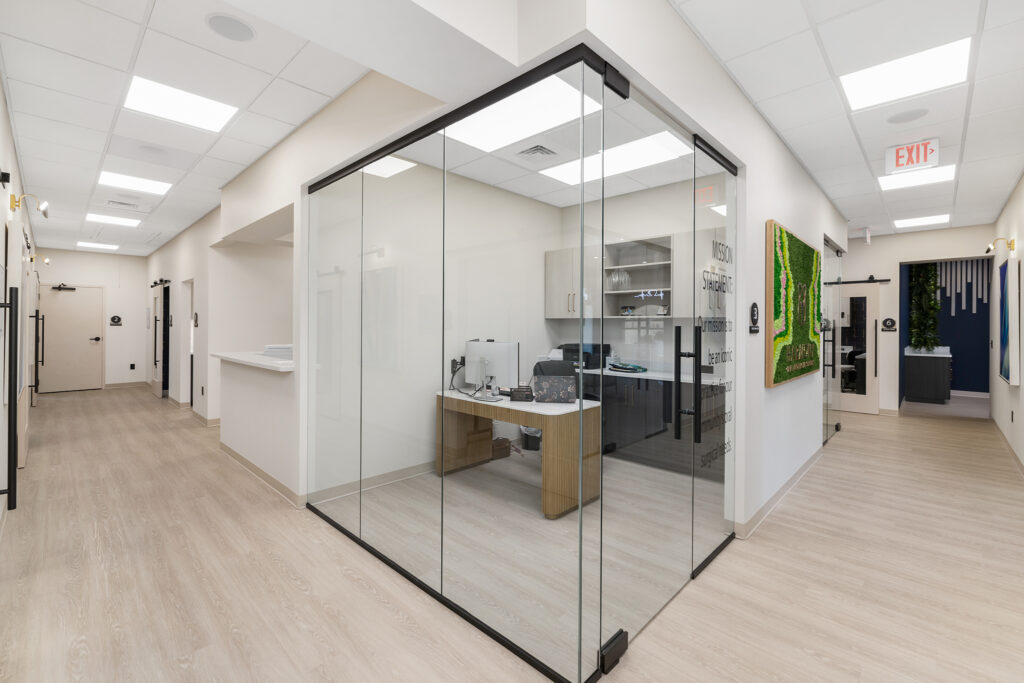
Last year, a landlord walked us through a spec suite that had been empty for eight months. The space itself was wine, it has lot’s pf room and nice light. The price was also quite affordable. Despite that, no one wanted to rent it and every prospective tenant who walked through said the same thing: I can’t picture my team here.
That’s the problem with empty space. It just doesn’t sell itself. And right now, a lot of commercial space is stuck in the same spot. National office vacancy is still above 17 percent in mid-2026, one of the highest stretches in decades.
For a landlord with a 3,000-square-foot spec suite, every month that space sits empty is lost momentum. The listing gets stale, competing spaces start looking better by comparison and your negotiating position on rent weakens.
Residential real estate solved this problem a long time ago. Nobody sells a house empty anymore if they can help it. They stage it, because buyers can’t picture themselves in bare rooms. Commercial owners are just now catching up to the same idea.
If you’re searching for how to reduce office vacancy, commercial staging is one of the most practical answers out there. It means furnishing and styling a spec suite, leasing office, or common area so it looks like somewhere a business could move in and get to work tomorrow. It’s not decoration for its own sake, but a real leasing strategy that happens to also make the space feel alive.
This brief guide explores commercial real estate staging, how it works and why it makes sense for commercial property owners.
What Is Commercial Staging?
Commercial staging is the professional furnishing and styling of office spec suites, leasing offices and commercial common areas. It’s done with one goal in mind: to help the space lease faster and at a better rate. It’s the same core idea behind residential staging, just pointed at a different kind of property. Here, we talk more about the commercial vs residential furniture specifics.
What does commercial property staging involve?
First, a staging team looks at the space. Then they pick furniture that fits the room and the kind of tenant you want to attract. After that, they handle delivery, install and styling.
The details matter here: desks, seating, lighting, plants, art. These are the small things that make a room feel finished instead of half-built.
There’s also a virtual version of this, where listing photos get digitally furnished instead of the room itself. Commercial virtual staging is cheaper and it can dress up a photo, but it doesn’t help once a tenant actually walks through the door and finds the same empty space.
It’s also worth drawing a line between staging and standard FF&E procurement services, because they sound similar but aren’t the same thing.
- FF&E procurement is outfitting a space permanently for the people who are going to work there long-term.
- Staging is temporary and lease-focused. Its whole purpose is to make the space perform better while it’s on the market, not to furnish it forever.
And here’s where commercial staging splits from its residential cousin: in a home sale, the staged furniture leaves the moment the deal closes. In commercial staging, it doesn’t have to.
Once a tenant signs a lease, they often have the option to simply buy or rent the furniture that’s already there. In this, the staged look can become the moved-in look, with no extra work on their end. We’ll get into exactly how that works in a bit because it’s one of the more useful parts of this whole approach.
Why Empty Offices Stay Vacant Longer
A property manager once told me she could always tell which listings would sit the longest just from the photos.
The empty ones, where potential tenants see only four walls, gray carpet and a window. The office is technically fine, but nothing in the room told a tenant what it was for. Those suites sat on the market for months while similar spaces down the street leased in weeks.
In fact, an empty space works against you in a few specific ways:
1. Scale and function
It might sound strange, but an empty room is hard to read. Without furniture to set the scale, a 2,000-square-foot commercial office doesn’t look like 2,000 square feet. It looks smaller and harder to picture as anything in particular.
Potential renters walk through and have to do all the imagining themselves: where would the desks go, would this layout even work for us, how many people could actually fit here. Most people aren’t good at that kind of mental exercise and a lot of them just won’t bother trying.
2. Photography
Listings live and die by their photos now. Most tenants and their reps are scrolling through images long before they ever schedule a tour. The photographs of an empty room are flat. There’s nothing to give it depth, warmth, or context and it tends to blend in with every other empty listing on the market. Fewer people click and fewer tours get booked.
3. Perception
This one is less about the space itself and more about what it signals to potential buyers. A suite that’s been sitting vacant for six or eight months starts to raise a question in people’s minds: Is something wrong with this space?
Put those three together and you get a space that’s technically available but functionally harder to lease with every month that passes.
Why Do Furnished Office Spaces Lease Faster?
The residential data on this is honestly pretty compelling. According to NAR’s 2025 Profile of Home Staging, a survey of about 1,200 real estate professionals, roughly half of the agents said staged homes sold more quickly than similar unstaged homes. About 30 percent of agents said home staging boosted the home’s value by 1 to 10 percent.
On top of that, 83 percent of buyers’ agents said staging made it easier for a buyer to picture the property as their future home and one in three buyer’s agents said clients were more likely to book a showing after seeing a staged listing online.
None of that is really about home décor. The key is how people make decisions when they can’t fully picture a space on their own. This is exactly the situation a commercial tenant is in when they walk through an empty spec suite.
A staged commercial space competes the same way a staged home does: better photos, easier tours and a faster mental leap from empty room to this could work.
Different types of commercial spaces run into this problem in slightly different ways, though. Here’s how it tends to break down:
| Space type | Main challenge when empty | What staging solves |
|---|---|---|
| Spec office suite | Hard for tenants to judge scale and layout | Shows real capacity and flow, makes tours land better |
| Leasing office | Feels transactional, not like a place to work | Creates a lived-in first impression for prospective tenants touring the property |
| Multifamily common area | Amenity spaces feel unfinished or generic | Makes the amenity feel like a real perk, not a placeholder |
| Co-working lobby | First impression sets the tone for the whole space | Signals energy and professionalism right at the entrance |
In this article, we elaborate more on furnished vs unfurnished commercial space: which leases faster and why.
What a Staged Spec Suite Looks Like
When we take on a spec suite, we start with the business, the brand, the space itself and who is likely to walk through the door as a prospective tenant. From there, the concept moves through a few defined stages:
| Stage | What happens |
|---|---|
| Concept development | Initial design direction based on brand identity and space requirements |
| Space planning | Layout optimized for flow, functionality and how a tenant would use the room |
| Mood boards & style guides | Visual direction that keeps furniture, finishes,and styling consistent |
| Design documentation | Detailed drawings and plans so execution matches the plan |
| Furniture selection & procurement | Sourcing furniture that fits the room and the target tenant profile |
| Delivery & install | Full in-house install that leaves the space genuinely move-in ready |
We handle the full range ourselves (selection, procurement, installation) all in-house, with no outside vendors involved.
A suite built for a tech company gets softer seating, open collaboration areas and a relaxed color palette. A suite built for a professional services firm gets defined offices, a proper conference table and a layout that signals structure. Every choice reflects the tenant we want to attract.
The Buy-or-Rent Option for Incoming Tenants
This is where commercial staging breaks away from its residential roots and it’s worth slowing down on because it changes the whole economics of the decision.
In residential staging, the furniture is a prop. It’s there to help sell the house and then it gets packed up and moved to the next listing the day after closing. Commercial staging doesn’t have to work that way. When a tenant signs a lease on a staged space, they’re given two straightforward options for the furniture that’s already in the room.
The first is to simply buy it. The tenant moves in, the furniture stay and they skip the entire process of sourcing, ordering, waiting on lead times and coordinating delivery. If you’ve ever furnished an office from scratch, you know it can eat weeks or months on its own. It’s move-in ready in the most literal sense: the desks are already where the desks should be.
The second option is to rent it on terms agreed upon upfront. This tends to make more sense for shorter leases, or for tenants who know they’ll want to furnish the space differently down the road but don’t want to deal with that on day one. It buys flexibility without forcing a big upfront furniture purchase before the business even knows how the space will be used long-term.
Either way, TNT sets the arrangement up as part of the staging process itself, which means the landlord isn’t left managing furniture inventory, negotiating with the incoming tenant, or figuring out logistics after the lease is signed. The staging that helped lease the space simply converts into the tenant’s move-in solution, with no extra step required from the landlord.
Here’s more about Job Corps furniture requirements for workforce housing.
| Buy | Rent | |
|---|---|---|
| Best for | Tenants ready to commit long-term | Shorter leases or tenants still deciding on their long-term setup |
| Upfront cost | One-time purchase | Lower upfront cost, spread over the lease term |
| Move-in timeline | Immediate – furniture stays in place | Immediate – furniture stays in place |
| Flexibility | Furniture is theirs to keep or change later | Can adjust or return as needs change |
| Landlord involvement | None – arrangement handled by TNT | None – arrangement handled by TNT |
| Sourcing effort required | None | None |
Who Benefits Most from Commercial Staging
Based on our experience in workplace projects staging pays off differently depending on where you sit in the leasing process.
- For developers and landlords, the case is mostly financial and it’s fairly direct. A staged space that leases 30 to 60 days faster than an unstaged comparable translates straight into recovered rent and less time carrying a vacant asset. On a spec suite where every month of vacancy chips away at net effective rent, that speed is the whole return on investment.
- For property managers, the benefit shows up in the numbers they’re already tracking. Staging tends to reduce days-on-market across a portfolio and gives you more room to hold your asking rent instead of leaning on concessions to move a stale listing. It’s less about any single suite and more about how the whole property performs over time.
- For commercial real estate agents and tenant reps, staging makes the day-to-day job easier. A staged space is simpler to show. Tours land better when the room already looks like somewhere a team could work and it photographs well enough to actually generate interest before anyone books a walkthrough. On top of that, having a move-in-ready option to point to can be the thing that closes a deal a client is still on the fence about.
- For tenants, the appeal is more practical: they get to walk into a furnished, functional office without the weeks or months that furniture procurement usually takes. No sourcing, no separate vendor to manage before they can open for business.
Four different vantage points, but they all land on the same outcome: a space that moves faster for everyone involved.
FAQs
What is commercial staging?
Commercial staging is the professional furnishing and styling of office spec suites, leasing offices and commercial common areas to help them lease faster and at better rates. It’s the same principle behind residential staging, applied to commercial real estate and it’s focused on lease acceleration rather than permanent furnishing.
Does staging help commercial spaces lease faster?
Yes. While commercial-specific data is still emerging, the principle is well established in residential real estate, where staged homes sell faster and for more, according to NAR. The same logic applies commercially: staged spaces photograph better, tour better and help tenants picture themselves in the space.
Can the tenant buy the furniture after signing the lease?
Yes. With TNT Commercial, tenants can choose to purchase the staged furniture outright at lease signing, giving them a fully move-in-ready office with no separate sourcing process. This option works well for tenants planning to stay long-term.
How much does commercial staging cost?
Cost varies based on square footage, furniture selection and space type. TNT Commercial provides project-specific quotes after an initial space assessment. For a more detailed look at procurement costs for commercial spaces, check out this FF&E cost breakdown.
What types of commercial spaces benefit most from staging?
Spec office suites, leasing offices, multifamily common areas, and co-working lobbies all benefit, though the reason differs slightly for each. Spec suites need help showing scale and layout, while leasing offices and common areas rely more on first impressions.

 info@tntcommercial.com