

What It Takes to Make the Office Worth the Commute
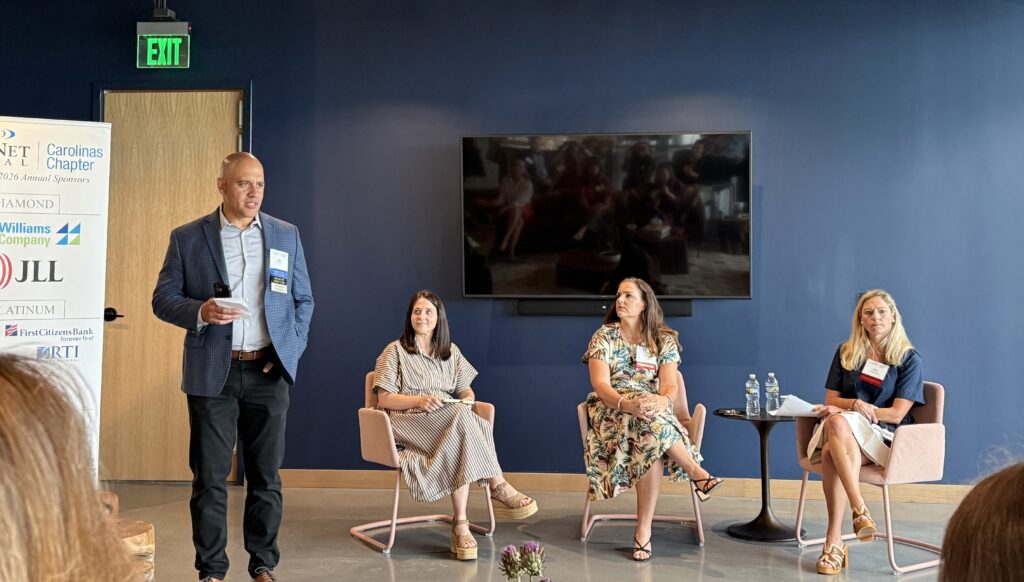
Last week, the TNT Commercial team attended a CoreNet Global event right here in Raleigh and walked away with pages of notes from a strikingly honest, grounded panel discussion on the state of the modern workplace.
The conversation centered on a challenge every employer is grappling with: How do you design a workplace – and the benefits and programming around it – that genuinely draws people in? Not because they have to come in to work, but because they want to.
The panel was led by a workplace strategy leader from a VR technology company managing dozens of sites and a real estate and facilities executive from a pharmaceutical manufacturer with major campuses in North Carolina’s Research Triangle. Different industries, different cultures, but strikingly aligned on what actually works.
Amenities are table stakes. Programming is the differentiator.
Fitness centers, cafés, coffee bars and collaborative lounges are increasingly expected at larger corporate campuses. What separates the companies with strong in-office attendance from the rest isn’t the amenity itself, but the programming wrapped around it.
One panelist described swimming pools with coached sessions, personal training staff, scheduled classes throughout the day and sports leagues that give employees a reason to be on campus at 4pm even on a slow Tuesday. The other talked about pickleball matches and volleyball games that keep people connected beyond their desks. The point wasn’t the sport, it was the moment.
“It’s creating that moment that matters. You have a pickleball match that afternoon – you stay. You run into someone in the hallway on the way out. That conversation wouldn’t have happened from home.”
The pharmaceutical company’s campus in the Research Triangle also highlighted something worth noting: Food is the single biggest attractor. Not the view, not the gym. Food. Accessible, quality breakfast and lunch, all-day coffee bars and smoothies, no 30-minute checkout lines. Remove the friction. Make it easier to be here than anywhere else.
Space design should follow actual behavior, not assumptions.
Both panelists admitted to the same learning the hard way: Post-pandemic, many companies built or converted enormous amounts of open, collaborative space based on the assumption that people returning to the office wanted to gather and brainstorm together.
In many cases, they didn’t. Engineering teams, support centers and focused-work groups often wanted exactly the opposite – heads-down workstations, dedicated monitors, and the quiet to get things done. The best workplace teams caught this early by listening to employees directly, tracking space utilization through sensors and focus groups, and being willing to pivot.
Hybrid flexibility and dedicated space can coexist.
Hot-desking and hoteling remain works in progress for most organizations. One panelist shared that some teams tried full hot-desk models and quickly found they needed a “neighborhood” – a predictable zone where their team would be present – even if the specific desk changed. Connection to a place, and to colleagues, still matters even in a flexible model.
The other company, growing quickly and running out of physical space, is actively evaluating how to right-size offices relative to actual in-office frequency without undermining the culture that makes their campuses work.
Location is a real estate decision and a talent decision simultaneously.
The conversation closed on a topic that resonates deeply with how we think about commercial real estate in the Triangle: Location strategy. Where you put your office shapes who comes and who stays. One panelist made the point that RTP’s position relative to multiple universities, Research Triangle communities and major employment corridors makes it one of the most investable corporate locations in the Southeast. The talent pipeline and the infrastructure are both here.
For employers evaluating new space, expansion or repositioning in the Raleigh metro, these are exactly the kinds of conversations that should inform your real estate strategy. Go beyond just square footage and lease terms.
Thinking about your workplace strategy?
TNT Commercial works with employers across the Triangle to align real estate decisions with business outcomes. Let’s talk about what your next office should accomplish.

 info@tntcommercial.com